
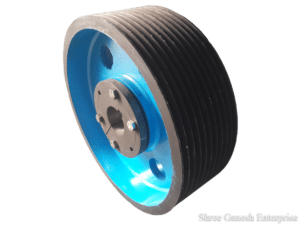
Selecting the correct taper lock pulley is not just about matching the belt profile or bore size. One of the most important technical factors is load capacity. If the pulley is undersized, it can lead to belt slip, overheating, shaft damage, or sudden failure. If it is oversized, you may be increasing costs unnecessarily.
This guide explains, in a practical and easy-to-understand way, how load capacity for a taper lock pulley is determined and what factors you must consider before finalizing your selection.
1. Understand the Type of Load
Before doing any calculation, identify the nature of the load:
- Light load (fans, blowers)
- Medium load (conveyors, packaging machines)
- Heavy load (crushers, mixers, compressors)
Heavy shock loads require a higher safety margin compared to steady loads. The operating condition directly affects pulley selection.
2. Calculate Power Transmission Requirement
Start with the basic motor details:
- Motor power (kW or HP)
- Motor speed (RPM)
- Required driven speed (RPM)
If power is given in HP, convert it to kW:
1 HP = 0.746 kW
This power value is the foundation for calculating torque.
3. Calculate Transmitted Torque
Torque determines how much rotational force the pulley must handle.
The standard formula is:
Torque (Nm) = (9550 × Power in kW) ÷ RPM
Example:
If a motor is 15 kW running at 1440 RPM:
Torque = (9550 × 15) ÷ 1440
Torque ≈ 99.5 Nm
This is the basic transmitted torque. However, this is not the final value you should use.
4. Apply Service Factor
Real-world applications rarely operate under ideal conditions. You must multiply the calculated torque by a service factor.
Typical service factors:
- Light duty: 1.0 – 1.2
- Medium duty: 1.3 – 1.5
- Heavy duty: 1.6 – 2.0
If the application is heavy duty and you use a service factor of 1.8:
Adjusted Torque = 99.5 × 1.8
Adjusted Torque ≈ 179 Nm
This adjusted torque is the minimum capacity your taper lock pulley system must handle.
5. Check Belt Tension Load
The pulley not only transmits torque but also experiences radial load due to belt tension.
Radial load depends on:
- Belt type (SPA, SPB, SPC, etc.)
- Number of grooves
- Belt tension rating
- Wrap angle
Manufacturers provide maximum allowable belt tension values per groove. Multiply the allowable tension by the number of grooves to estimate total load capacity.
If the belt tension exceeds pulley limits, premature wear or cracking may occur.
6. Verify Taper Bush Torque Capacity
The taper lock bush also has a torque limit. Even if the pulley body is strong enough, the bush must securely transmit torque to the shaft.
Check:
- Bush size
- Shaft diameter
- Maximum permissible torque rating
Always ensure the bush torque rating is higher than your adjusted torque requirement.
7. Consider Pulley Material Strength
Most taper lock pulleys are made from graded cast iron. The material must withstand:
- Shear stress
- Bending stress
- Repeated load cycles
For heavy-duty applications, high-grade cast iron provides better strength and shock absorption. Inferior material reduces load capacity and increases risk of failure.
8. Check Shaft Diameter Compatibility
The shaft must also support the transmitted load. If the shaft diameter is too small, even a strong pulley will not solve the issue.
Ensure:
- Shaft diameter matches torque requirement
- Keyway dimensions are correct
- No excessive overhang load
Proper alignment between shaft and pulley improves load handling capacity.
9. Factor in Speed and Dynamic Conditions
High RPM applications generate additional centrifugal force and vibration. For high-speed operations:
- Ensure proper balancing
- Verify dynamic load limits
- Confirm safe operating RPM range
Ignoring speed-related stress can reduce pulley life.
10. Final Safety Margin
After completing all calculations, it is wise to maintain a reasonable safety margin. Industrial systems are subject to fluctuations, start-stop cycles, and unexpected overloads.
Choosing a pulley that operates comfortably within its rated capacity ensures:
- Longer service life
- Reduced maintenance
- Better reliability
- Lower downtime risk
Conclusion
Calculating taper lock pulley load capacity involves more than just looking at motor power. You must evaluate torque, service factor, belt tension, bush capacity, shaft size, and operating conditions.
A properly calculated and selected pulley ensures smooth power transmission, improved efficiency, and long-term durability. Taking time to perform accurate load analysis is a smart investment that protects both equipment and productivity.
If you require assistance in selecting the correct taper lock pulley based on your application load conditions, SHREE GANESH ENTERPRISE provides technical guidance to help you choose the most reliable solution for your system.
