
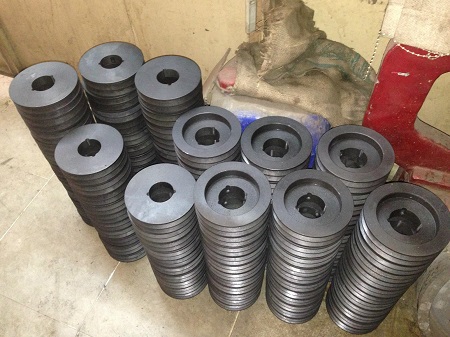
When selecting taper lock pulleys for industrial applications, one common question arises: should you choose a standard pulley or go for a custom design? The answer depends on your machine requirements, load conditions, lead time expectations, and long-term operational goals.
Understanding the difference between standard and custom taper lock pulleys helps you make a cost-effective and technically sound decision.
What Are Standard Taper Lock Pulleys?
Standard pulleys are manufactured according to established dimensional norms and common belt profiles such as SPZ, SPA, SPB, and SPC. They are readily available in predefined diameters, groove numbers, and bush sizes.
Advantages of Standard Pulleys
- Faster availability
- Lower cost due to mass production
- Interchangeability with standard taper bushes
- Suitable for common industrial applications
- Easier replacement and maintenance
Standard pulleys are ideal when your machine design follows widely accepted industry dimensions.
When to Choose Standard
You should select standard pulleys when:
- Shaft size matches common bush sizes
- Belt profile is standard
- Load conditions are typical
- No space constraints exist
- Quick delivery is required
For most conveyors, compressors, fans, and general-purpose drives, standard pulleys are sufficient.
What Are Custom Taper Lock Pulleys?
Custom pulleys are designed and manufactured according to specific application requirements that go beyond standard catalog dimensions.
Customization may involve:
- Special outer diameters
- Non-standard groove profiles
- Additional machining features
- Unique hub dimensions
- Modified bore or keyway requirements
- Heavy-duty reinforcement
Custom pulleys are typically used in specialized machinery or unique industrial systems.
Advantages of Custom Pulleys
- Designed for specific load conditions
- Optimized for space limitations
- Improved performance in critical applications
- Ability to handle unusual speed or torque requirements
Custom designs allow engineers to fine-tune performance.
Key Factors to Consider Before Deciding
1. Load and Torque Requirement
If your torque calculation fits within standard pulley capacity, there is no need for customization. However, if the application involves extreme loads or shock conditions, a custom design may provide better durability.
2. Space Constraints
Limited installation space may require:
- Reduced hub length
- Special diameter
- Compact multi-groove design
In such cases, custom pulleys are often necessary.
3. Operating Speed
High-speed applications may require:
- Precision balancing
- Specific material grade
- Modified wall thickness
If standard options do not meet RPM limits, custom solutions may be required.
4. Budget and Lead Time
Standard pulleys are more economical and available quickly. Custom pulleys involve design time, tooling adjustments, and longer production cycles.
If time is critical, standard is usually the better choice.
5. Replacement and Spare Management
Standard pulleys simplify spare management because they are easily replaceable and widely available.
Custom pulleys may require reordering from the original manufacturer, which could increase downtime if not planned properly.
Cost Comparison
Standard pulleys:
- Lower upfront cost
- Lower production complexity
- High availability
Custom pulleys:
- Higher initial cost
- Design and approval process required
- Longer delivery timeline
However, custom pulleys may reduce long-term maintenance cost if designed specifically for demanding applications.
Common Mistakes to Avoid
- Choosing custom when standard would work
- Ignoring torque calculations
- Over-specifying design unnecessarily
- Selecting standard without checking space constraints
- Not considering future spare availability
The right choice balances performance, cost, and practicality.
Final Thoughts
In most industrial applications, standard taper lock pulleys provide reliable and cost-effective performance. They are suitable for common belt sections and normal operating conditions.
Custom taper lock pulleys are best reserved for applications involving unusual loads, space limitations, or specialized machine designs.
Before placing an order, evaluate your torque requirements, shaft size, operating speed, and installation constraints. Making the correct decision ensures efficient power transmission, reduced downtime, and optimal return on investment.
