
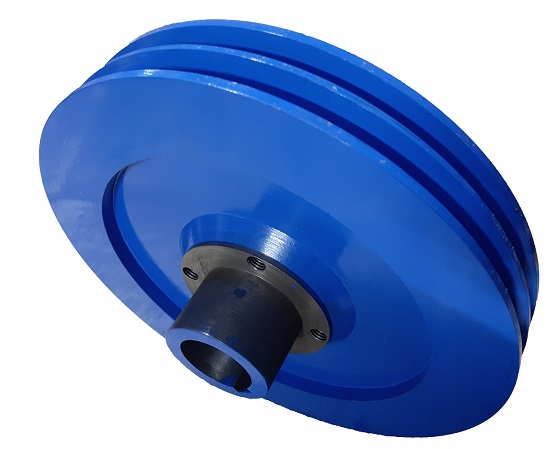
Correct pulley diameter selection is essential for efficient belt drive performance. Choosing the wrong diameter can result in belt slippage, overheating, reduced torque transmission, excessive vibration, and shorter belt life. Whether you are designing a new system or modifying an existing one, understanding how to calculate pulley diameter ensures smooth and reliable power transmission.
This guide by Shree Ganesh Enterprise explains the practical method used in industrial belt drive systems.
Step 1: Understand the Speed Ratio Requirement
Pulley diameter is primarily determined by the speed ratio between the driving and driven shafts.
The basic formula is:
Driver RPM × Driver Diameter = Driven RPM × Driven Diameter
From this, you can calculate:
Driven Diameter = (Driver RPM × Driver Diameter) ÷ Driven RPM
This relationship is based on the principle that belt speed remains constant across both pulleys (ignoring minor slip).
Example
If:
- Motor speed = 1440 RPM
- Required driven speed = 720 RPM
- Driver pulley diameter = 100 mm
Then:
Driven Diameter = (1440 × 100) ÷ 720
Driven Diameter = 200 mm
This means you need a 200 mm driven pulley to achieve the desired speed reduction.
Step 2: Consider Minimum Recommended Pulley Diameter
Each belt section (SPZ, SPA, SPB, SPC, etc.) has a minimum recommended pulley diameter. Using a diameter smaller than recommended can:
- Increase belt bending stress
- Reduce belt life
- Cause excessive heat
Always refer to the belt manufacturer’s minimum diameter chart before finalizing your pulley size.
Step 3: Calculate Belt Speed
Belt speed affects system efficiency and performance. It is calculated as:
Belt Speed (m/min) = (π × Pulley Diameter × RPM) ÷ 1000
High belt speeds may cause:
- Increased centrifugal force
- Reduced belt grip
- Higher wear
Industrial V-belt systems typically operate efficiently within recommended belt speed ranges.
Step 4: Check Torque Requirement
Pulley diameter directly influences torque transmission.
Torque (Nm) = (9550 × Power in kW) ÷ RPM
If you increase pulley diameter on the driven side, torque increases proportionally as speed decreases.
Ensure that:
- Pulley size supports required torque
- Taper lock bush capacity matches torque
- Shaft diameter is sufficient
Ignoring torque calculation can result in pulley failure.
Step 5: Consider Center Distance
Pulley diameter must fit within available machine space.
Factors to check:
- Center distance between shafts
- Belt length availability
- Clearance from nearby components
Large pulleys improve belt life but may not fit in compact designs.
Step 6: Evaluate Load Type and Service Factor
Different applications require different safety margins.
Apply service factors based on:
- Light load (fans, blowers)
- Medium load (conveyors)
- Heavy load (crushers, mixers)
Heavy shock loads may require larger pulley diameters or multiple belts.
Step 7: Account for Slip
In real-world systems, slight belt slip occurs. Although calculations assume no slip, practical designs include a small safety margin to compensate.
High-quality pulleys with accurate groove profiles reduce slip and improve performance.
Common Mistakes to Avoid
- Selecting diameter based only on speed ratio
- Ignoring minimum belt diameter recommendation
- Not checking torque capacity
- Using undersized pulleys to save space
- Overlooking service factor
Accurate calculation prevents long-term operational issues.
Quick Selection Checklist
Before finalizing pulley diameter:
- Confirm motor RPM
- Confirm required driven RPM
- Apply speed ratio formula
- Check minimum belt diameter
- Verify torque capacity
- Ensure space availability
Following these steps ensures a properly designed belt drive system.
Final Thoughts
Calculating pulley diameter for belt drive systems is a balance between speed ratio, torque requirements, belt limitations, and available space. A well-calculated pulley size improves efficiency, reduces wear, and ensures long-term reliability.
Proper engineering at the selection stage prevents costly corrections after installation.
