
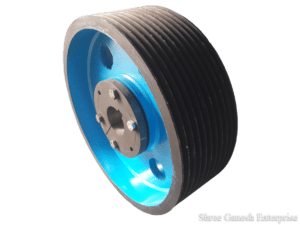
The cement industry operates under some of the toughest industrial conditions. Equipment runs continuously, handles heavy loads, and functions in dusty, abrasive environments. In such demanding applications, every power transmission component must be strong, stable, and reliable.
Taper lock pulleys are widely used in cement plants because they provide secure shaft mounting, efficient torque transmission, and easier maintenance compared to conventional mounting systems.
Why Cement Plants Need Heavy-Duty Pulley Systems
Cement manufacturing involves processes such as crushing, grinding, conveying, mixing, and kiln operation. These processes generate:
- High shock loads
- Continuous duty cycles
- Heavy material handling stress
- Extreme dust exposure
A pulley used in this environment must resist wear, vibration, and misalignment while maintaining stable belt performance.
Key Applications in Cement Industry
Taper lock pulleys are commonly used in:
- Belt conveyors
- Raw material crushers
- Ball mills
- Bucket elevators
- Kiln drive systems
- Clinker handling units
These machines demand consistent torque transmission and minimal downtime.
Advantages of Taper Lock Pulleys in Cement Plants
1. Strong Shaft Grip Under Heavy Load
The taper lock bush system creates uniform clamping pressure around the shaft. This prevents slippage during:
- Heavy start-up loads
- Sudden load variations
- Continuous operation
Secure mounting is essential in cement processing equipment.
2. Easy Installation and Removal
Maintenance time in cement plants directly affects production output. Taper lock pulleys allow:
- Quick installation
- Easy removal using jacking screws
- Minimal shaft damage
- Faster replacement during shutdown
Reduced maintenance time increases plant efficiency.
3. Vibration Control
Heavy machinery such as crushers and mills generates significant vibration. High-grade cast iron pulleys absorb vibration better than rigid systems.
This results in:
- Longer bearing life
- Reduced belt wear
- Improved machine stability
4. Dust Resistance and Durability
Cement plants operate in extremely dusty environments. Properly coated taper lock pulleys with anti-corrosion finish help:
- Resist rust formation
- Maintain structural strength
- Protect machined surfaces
Regular cleaning and inspection further extend service life.
Important Selection Factors for Cement Applications
When choosing taper lock pulleys for cement plants, consider:
- High service factor due to shock loads
- Correct belt section (SPB or SPC commonly used)
- Larger diameter for better belt life
- Heavy-duty bush series
- Dynamic balancing for high-speed systems
- Proper alignment and tensioning
Undersized pulleys in cement applications lead to frequent failures.
Material Consideration
Most cement industry pulleys are manufactured from high-grade cast iron because of:
- High compressive strength
- Good wear resistance
- Vibration damping properties
In extremely high-impact areas, fabricated steel pulleys may also be used.
Common Problems to Avoid
- Ignoring torque calculation
- Using smaller groove profiles to reduce cost
- Improper bush tightening
- Operating with incorrect belt tension
- Delayed maintenance checks
Preventive inspection is critical in cement plants.
Maintenance Recommendations
For longer life in cement applications:
- Inspect screw tightness regularly
- Check alignment quarterly
- Monitor vibration levels
- Clean dust accumulation
- Replace worn belts promptly
Proactive maintenance reduces sudden breakdowns.
Final Thoughts
The cement industry demands robust, reliable, and easy-to-maintain power transmission systems. Taper lock pulleys provide strong shaft grip, simplified maintenance, and dependable torque transfer under extreme conditions.
When properly selected and installed, they contribute to reduced downtime, improved operational efficiency, and longer equipment life in cement manufacturing environments.
