
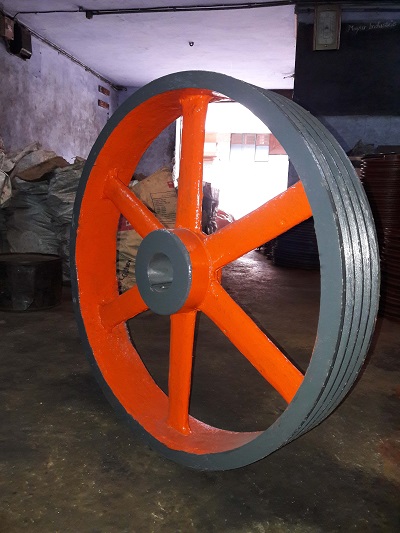
At Shree Ganesh Enterprise, buyers approaching us for V-belt pulleys rarely begin with price — they begin with specifications.
They want to confirm the correct diameter for their RPM, the right material for their load, proper groove accuracy for their belt section, and machining tolerances that ensure vibration-free performance.
Because for serious industrial buyers, a V-belt pulley is not just a component — it is a performance decision.
This guide addresses the key technical details buyers evaluate before placing a final order.
What Exactly Is a V-Belt Pulley and Why Does It Matter?
A V-belt pulley is a grooved wheel that transmits power between shafts using V-belts. The angled groove design increases friction and ensures proper grip.
For me as a buyer, it matters because:
- It determines speed ratio
- It affects torque transmission
- It impacts belt life
- It influences vibration and energy efficiency
- It directly affects machine reliability
A poorly machined pulley will reduce belt life and increase maintenance cost.
Step 1: What Belt Section Am I Using?
Before ordering, I must confirm the belt type:
- Classical sections: A, B, C, D
- Narrow sections: SPA, SPB, SPC
- Multiple groove belts
- Custom profiles
If the groove profile does not perfectly match the belt section, I will face:
- Slippage
- Excessive heat
- Premature belt wear
- Power loss
This is non-negotiable.
Step 2: What Speed Ratio Do I Need?
To determine pulley size, I must know:
- Motor RPM
- Driven shaft RPM
- Desired output speed
The formula I rely on:
Driver RPM × Driver Diameter = Driven RPM × Driven Diameter
If I select the wrong diameter, the entire machine performance will suffer.
A reliable manufacturer should assist me in confirming the correct ratio.
Step 3: What Material Should I Choose?
Material affects durability and application suitability.
Cast Iron
- Good wear resistance
- Cost-effective
- Ideal for general industrial use
Steel
- Higher strength
- Suitable for heavy loads
- Better shock resistance
SG Iron (Ductile Iron)
- Higher tensile strength than grey cast iron
- Better impact resistance
Before ordering, I ask:
- What is the exact material grade?
- Is it properly tested?
- Is it suitable for my load and RPM?
Step 4: What Bore and Mounting Type Do I Need?
I must decide:
- Pilot bore or finished bore?
- With keyway?
- Taper lock bush system?
Taper Lock Advantages:
- Easy installation
- Better shaft grip
- Easy removal
- Reduced downtime
For maintenance-friendly operations, taper lock systems are often preferable.
Step 5: What Load and Horsepower Must It Handle?
I must verify:
- Required HP/kW transmission
- Number of grooves required
- Service factor (continuous or intermittent duty)
Underestimating load capacity can result in:
- Groove cracking
- Belt slip
- Shaft damage
I expect the manufacturer to help validate my application data.
Step 6: What Quality Checks Should I Expect?
Before placing a bulk order, I want confirmation of:
- Dimensional accuracy
- Bore tolerance
- Keyway precision
- Groove profile accuracy
- Static or dynamic balancing
- Surface finish quality
Poor balancing causes vibration and shortens bearing life.
Step 7: What Tolerances Are Acceptable?
For industrial applications, I verify:
- Bore tolerance fit
- Runout limits
- Concentricity
- Groove spacing accuracy
Precision machining ensures smooth power transmission.
Step 8: What Are the Signs of a Low-Quality Pulley?
As a buyer, I avoid:
- Rough casting surface
- Uneven grooves
- Excessive paint thickness hiding defects
- Poor machining finish
- No material traceability
Price alone should never determine my decision.
Step 9: Should I Choose Standard or Custom?
Standard pulleys are suitable when:
- Dimensions match my exact requirement
- Delivery time is urgent
Custom pulleys are required when:
- Special bore size
- Special groove profile
- Heavy-duty application
- OEM integration
I prefer manufacturers capable of both.
Step 10: What Documents Should I Ask Before Finalizing?
Before issuing a purchase order, I request:
- Technical drawing confirmation
- Material specification
- Inspection report
- Balancing confirmation
- Delivery timeline
Professional documentation builds confidence.
Final Checklist Before Ordering
- Confirm belt section
- Confirm RPM and speed ratio
- Confirm load capacity
- Confirm material grade
- Confirm bore and mounting type
- Confirm balancing
- Confirm tolerances
- Request inspection documentation
Only after these confirmations do I feel confident placing my order.
Final Thoughts as a Buyer
When I purchase a V-belt pulley, I am not just comparing price — I am evaluating:
- Engineering support
- Manufacturing capability
- Quality control process
- Customization flexibility
- Long-term reliability
A dependable V Belt pulley manufacturer should act as a technical partner, not just a supplier.
If I want consistent performance, reduced downtime, and long belt life, I must choose carefully.
