
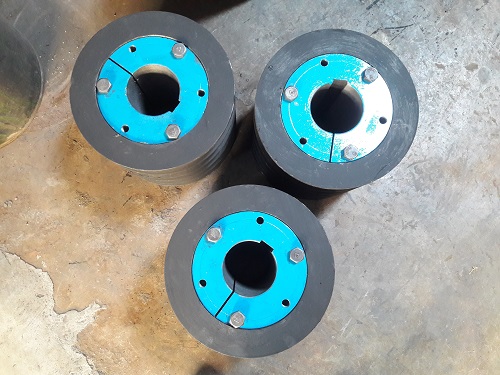
Ordering 100 or more pulleys is not just a purchase decision — it is a production and investment decision. A mistake in specification, quality, or supplier evaluation can affect multiple machines at once and lead to large-scale downtime.
Before placing a bulk order, it is important to verify technical details, quality consistency, and supplier capability. This guide outlines the key checkpoints you should review before confirming a high-volume pulley purchase.
1. Confirm Exact Technical Specifications
In bulk orders, even a small specification error multiplies across every unit.
Verify:
- Pulley diameter
- Belt section (SPA, SPB, SPC, etc.)
- Number of grooves
- Taper bush size
- Bore and keyway dimensions
- Material grade
Always match the specifications with machine requirements or approved drawings. If possible, request a technical drawing confirmation before production begins.
2. Recalculate Load and Torque Requirements
Before ordering in large quantities, double-check:
- Motor power
- Operating RPM
- Service factor
- Duty cycle
Confirm that the selected pulley size comfortably handles the calculated torque and belt load. Bulk purchases should be future-proof, not just suitable for current conditions.
3. Verify Material Quality and Grade Consistency
Material variation in bulk supply can lead to inconsistent performance.
Check for:
- Material test certificates
- Casting quality standards
- Hardness range consistency
- Absence of porosity or cracks
If possible, request a sample unit before final approval of mass production.
4. Inspect Manufacturing Tolerances
Dimensional consistency is critical when ordering 100+ pulleys.
Ensure:
- Uniform groove profile
- Correct taper angle
- Accurate bore tolerance
- Controlled runout and concentricity
Inconsistent tolerances may cause vibration or belt wear across multiple machines.
5. Check Taper Lock Bush Compatibility
If bushes are ordered separately or sourced locally, confirm:
- Standard taper dimensions
- Screw alignment
- Proper seating depth
- Interchangeability compliance
Bulk mismatch issues can be costly to rectify later.
6. Ask About Balancing (If Required)
For high-speed or critical applications, confirm whether pulleys are:
- Statically balanced
- Dynamically balanced
- Within acceptable vibration limits
Balancing requirements should be clearly stated in the purchase order.
7. Evaluate Supplier Production Capacity
Before confirming 100+ units, assess:
- Production capability
- Lead time commitment
- Batch-to-batch consistency
- Quality control process
Bulk supply requires stable manufacturing, not just one-time production capability.
8. Confirm Packaging Standards
Improper packaging can damage products during transport.
Ensure:
- Individual protective wrapping
- Anti-rust coating if required
- Strong cartons or wooden crates
- Clear labeling
Good packaging prevents transit-related losses.
9. Clarify Commercial Terms
Large orders involve significant capital.
Confirm:
- Delivery timeline
- Payment terms
- Warranty coverage
- Replacement policy for defective units
Clear documentation avoids disputes later.
10. Request Sample Approval (If Possible)
For first-time suppliers or new designs, request:
- One approved sample
- Pre-dispatch inspection photos
- Quality inspection report
Approving a sample reduces risk before full production.
Common Mistakes in Bulk Orders
- Copying old specifications without rechecking load
- Ignoring service factor
- Focusing only on price
- Not confirming bush compatibility
- Skipping pre-production approval
Bulk errors are expensive because they affect multiple installations.
Final Thoughts
Ordering 100+ pulleys requires careful planning and technical validation. A structured review process ensures consistent performance, reduced downtime, and long-term operational reliability.
Bulk purchasing should not be rushed. Verifying specifications, quality standards, and supplier reliability before placing the order protects your investment and ensures smooth machine performance across all units.
