
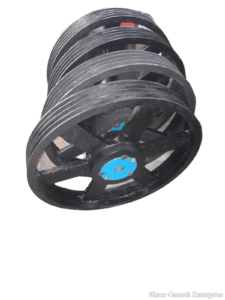
When selecting taper lock pulleys for heavy-duty industrial applications, one common question arises: should you choose cast iron or steel? Both materials are widely used, but their performance characteristics differ depending on load, speed, impact conditions, and operating environment.
Choosing the right material directly affects durability, vibration control, maintenance frequency, and overall system reliability.
Understanding Cast Iron Taper Lock Pulleys
Cast iron is the most commonly used material for industrial pulleys. It offers a strong balance between strength, machinability, vibration absorption, and cost efficiency.
Advantages of Cast Iron
- Excellent vibration damping
- Good wear resistance
- Stable dimensional accuracy
- Cost-effective for large production
- Suitable for most industrial drives
Cast iron naturally absorbs vibration better than steel. This makes it ideal for applications where smooth operation and reduced noise are important.
Where Cast Iron Performs Well
- Conveyors
- Compressors
- Fans and blowers
- Packaging machinery
- General manufacturing equipment
For most heavy-duty applications with steady loads, high-grade cast iron pulleys perform reliably.
Understanding Steel Taper Lock Pulleys
Steel pulleys are typically fabricated or machined from solid steel. They are used in applications where extreme strength and impact resistance are required.
Advantages of Steel
- Higher tensile strength
- Better impact resistance
- Suitable for shock loading
- Less prone to brittle fracture
Steel is generally tougher than cast iron, especially in applications involving sudden or heavy impact loads.
Where Steel Is Preferred
- Crushers
- Mining equipment
- Heavy mixers
- Stone processing plants
- Applications with severe shock loads
Steel pulleys are often chosen when operating conditions are extremely demanding.
Key Comparison Factors
1. Strength
Steel generally has higher tensile strength compared to cast iron. For applications involving very high torque or impact loads, steel may offer an advantage.
However, high-grade cast iron is more than sufficient for most heavy industrial systems.
2. Vibration Damping
Cast iron absorbs vibration better than steel. In continuous-running systems, this reduces stress on bearings and belts.
Steel transmits vibration more directly, which may require additional balancing or support.
3. Weight
Steel pulleys are often heavier than cast iron equivalents, especially in fabricated designs. Increased weight can influence shaft loading and bearing selection.
4. Cost
Cast iron pulleys are typically more economical due to simpler casting processes and mass production efficiency.
Steel pulleys involve more machining and fabrication, making them more expensive.
5. Failure Behavior
Cast iron is strong but can be brittle under extreme impact. Steel is more ductile and better suited for repeated shock loading.
Proper material selection should be based on application stress rather than general assumptions.
Which Is Better for Heavy Duty?
For most heavy-duty industrial applications involving steady loads, conveyors, compressors, and standard power transmission systems, high-grade cast iron taper lock pulleys are fully reliable and cost-effective.
Steel pulleys are better suited for extreme shock conditions, high-impact environments, and specialized machinery where tensile strength and toughness are critical.
The decision should depend on:
- Load type (steady vs shock)
- Torque requirement
- Operating speed
- Environmental conditions
- Budget considerations
Common Mistake to Avoid
Do not assume that “heavier” or “stronger” automatically means better. Over-specifying material increases cost without improving performance in normal industrial conditions.
Correct load calculation and application analysis are more important than simply choosing the strongest material available.
Final Thoughts
Both cast iron and steel taper lock pulleys have their place in industrial machinery. Cast iron offers excellent vibration damping and cost efficiency for most heavy-duty systems, while steel provides superior toughness for extreme impact applications.
Selecting the right material ensures long service life, reduced maintenance, and optimal performance under real operating conditions.
