
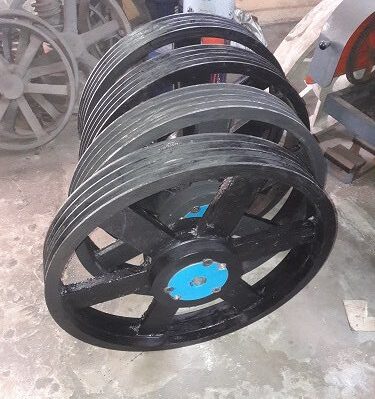
Selecting the right taper lock pulley is not just about matching a belt and shaft. The correct choice directly impacts torque transmission, belt life, vibration levels, and overall machine reliability. A poorly selected pulley can lead to slippage, overheating, premature wear, and costly downtime.
This guide explains the step-by-step approach to choosing the correct taper lock pulley for your specific application.
Step 1: Understand Your Power Requirement
Start with basic motor details:
- Motor power (kW or HP)
- Motor speed (RPM)
- Required driven speed (RPM)
These values help determine the speed ratio and torque requirement.
Use the formula:
Torque (Nm) = (9550 × Power in kW) ÷ RPM
Then apply a service factor based on load type:
- Light duty → 1.2
- Medium duty → 1.4–1.5
- Heavy duty → 1.6–2.0
The adjusted torque determines the minimum pulley and bush capacity.
Step 2: Select the Correct Belt Section
The groove profile must match the belt section exactly.
Common belt sections:
- SPZ → Light-duty systems
- SPA → Medium-light applications
- SPB → Medium-heavy applications
- SPC → Heavy-duty systems
Choosing the wrong groove type reduces power transmission efficiency and increases wear.
Step 3: Calculate the Required Pulley Diameter
Pulley diameter determines speed ratio.
Use:
Driver RPM × Driver Diameter = Driven RPM × Driven Diameter
Ensure the selected diameter:
- Meets required output speed
- Does not fall below minimum recommended belt diameter
- Fits within available machine space
Larger diameters improve belt life but require more installation space.
Step 4: Choose the Correct Number of Grooves
The number of grooves affects load capacity.
Higher load applications may require:
- Multiple belts
- Additional grooves
More grooves distribute load evenly and reduce stress per belt.
Step 5: Select the Proper Taper Lock Bush
The bush connects the pulley to the shaft securely.
To choose the correct bush:
- Measure shaft diameter precisely
- Confirm shaft tolerance
- Match bush series to pulley hub
- Ensure torque rating exceeds calculated requirement
Never assume shaft size — always measure.
Step 6: Consider Operating Conditions
Environmental and operational factors influence selection:
- Dusty environments
- High temperature
- Continuous operation
- Shock loading
- High RPM
For high-speed applications, consider dynamically balanced pulleys to reduce vibration.
Step 7: Check Installation Space and Alignment
Before finalizing:
- Confirm center distance
- Ensure proper belt wrap angle
- Check shaft overhang limits
- Verify clearance from nearby components
Incorrect spacing affects performance and maintenance access.
Step 8: Evaluate Material Selection
Most industrial pulleys are made from graded cast iron due to:
- Good strength
- Vibration damping
- Cost efficiency
For extreme shock loads, steel may be considered.
Material selection should match application severity.
Step 9: Plan for Maintenance and Spare Management
Standardized pulley and bush systems simplify:
- Replacement
- Inventory control
- Future upgrades
Avoid non-standard sizes unless technically required.
Common Mistakes to Avoid
- Selecting pulley based only on diameter
- Ignoring service factor
- Not measuring shaft size
- Over-tightening during installation
- Skipping torque verification
Correct selection prevents long-term mechanical issues.
Final Thoughts
Choosing the right taper lock pulley requires careful consideration of power, speed, torque, belt type, shaft size, and operating conditions. A structured selection process ensures efficient power transmission, reduced downtime, and longer equipment life.
Taking time during the selection stage prevents expensive corrections later and ensures reliable performance across your system.
