
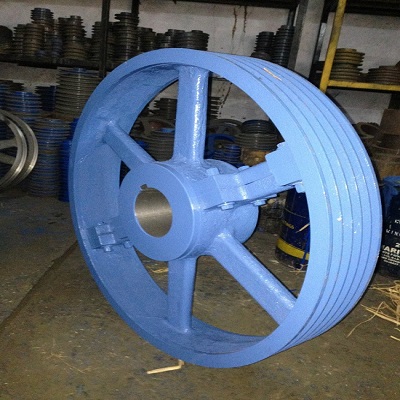
Selecting the right V-belt pulley is not just a technical task—it is a critical buying decision that directly affects machine performance, efficiency, and operating cost. Many buyers face issues like incorrect speed, belt slippage, or frequent breakdowns simply because pulley calculations were not done correctly.
This guide is designed to help buyers clearly understand how to calculate pulley diameter, speed ratio, and RPM, so you can make accurate and confident purchasing decisions.
Understanding the Basics
| Term | Meaning |
|---|---|
| Driver Pulley | Pulley connected to the motor |
| Driven Pulley | Pulley connected to the machine |
| RPM | Rotations per minute |
| Pitch Diameter | Effective diameter where belt runs (important for calculation) |
| Speed Ratio | Relationship between input and output speed |
Core Formula You Must Know
Driver RPM × Driver Diameter = Driven RPM × Driven Diameter
This is the most important formula used in all pulley calculations.
Speed Ratio Explained
Speed Ratio = Driver RPM ÷ Driven RPM
OR
Speed Ratio = Driven Diameter ÷ Driver Diameter
This helps buyers quickly understand whether speed will increase or decrease.
Pulley Diameter Calculations
To calculate driven pulley diameter:
Driven Diameter = (Driver RPM × Driver Diameter) ÷ Driven RPM
To calculate driver pulley diameter:
Driver Diameter = (Driven RPM × Driven Diameter) ÷ Driver RPM
Quick Calculation Table
| Known Values | Formula Used | Result |
|---|---|---|
| Driver RPM, Driver Dia, Driven RPM | (Driver RPM × Driver Dia) ÷ Driven RPM | Driven Diameter |
| Driven RPM, Driven Dia, Driver RPM | (Driven RPM × Driven Dia) ÷ Driver RPM | Driver Diameter |
| Both Diameters | Driven Dia ÷ Driver Dia | Speed Ratio |
Practical Examples for Buyers
Example 1: Reducing Machine Speed
Motor RPM = 1440
Driver Pulley = 100 mm
Required Machine Speed = 720 RPM
Driven Diameter = (1440 × 100) ÷ 720 = 200 mm
Result: Speed reduces by half, torque increases.
Example 2: Increasing Machine Speed
Motor RPM = 1000
Driver Pulley = 200 mm
Driven Pulley = 100 mm
Driven RPM = (1000 × 200) ÷ 100 = 2000 RPM
Result: Speed doubles, torque reduces.
Example 3: Conveyor Application (Real Industry Case)
Requirement: Slow-moving conveyor
Motor RPM = 1440
Driver Pulley = 80 mm
Desired Conveyor Speed = 480 RPM
Driven Diameter = (1440 × 80) ÷ 480 = 240 mm
Result: Smooth and controlled conveyor movement.
How Pulley Selection Affects Your Purchase
| Selection Factor | Impact on Buyer |
|---|---|
| Incorrect Diameter | Wrong speed output |
| Wrong Ratio | Machine inefficiency |
| Ignoring Pitch Dia | Calculation errors |
| Wrong Belt Type | Poor performance |
| Oversized Pulley | Space and cost issues |
Standard Buyer Guidelines
Always Follow These
• Use pitch diameter, not outer diameter
• Match pulley with correct belt type (SPA, SPB, SPC)
• Confirm motor RPM before calculation
• Consider load and torque requirement
• Choose standard sizes when possible for faster availability
Avoid These Mistakes
• Guessing pulley sizes
• Ignoring speed ratio
• Mixing incompatible belt and pulley types
• Not consulting supplier for final confirmation
Quick Reference Guide
| Driver Pulley | Driven Pulley | Result |
|---|---|---|
| Smaller | Larger | Speed decreases, torque increases |
| Larger | Smaller | Speed increases, torque decreases |
| Equal | Equal | Speed remains same |
Frequently Asked Questions
What happens if I increase the driven pulley size?
The output speed decreases and torque increases, which is useful for heavy-duty applications.
Can I use outer diameter for calculation?
No, always use pitch diameter for accurate and reliable results.
What is the common motor RPM used in industry?
Typically 1440 RPM or 2880 RPM depending on motor configuration.
How do I increase machine speed?
Use a larger driver pulley or a smaller driven pulley.
Does belt type affect pulley calculation?
Yes, belt sections like SPA, SPB, and SPC determine compatible pulley sizes and performance.
Final Thoughts
Correct pulley calculation is the foundation of efficient machine operation. Even a small error in diameter or speed ratio can lead to performance issues, higher maintenance costs, and reduced equipment life.
From a buyer’s perspective, understanding these calculations ensures:
• Correct product selection
• Reduced downtime
• Better communication with suppliers
• Long-term cost savings
At Shree Ganesh Enterprise, we help buyers select the right V-belt pulley combinations based on exact application requirements, ensuring performance, reliability, and value.
A well-calculated V belt pulley system is not just a component choice—it is a smart investment in your machine’s efficiency and productivity.
