
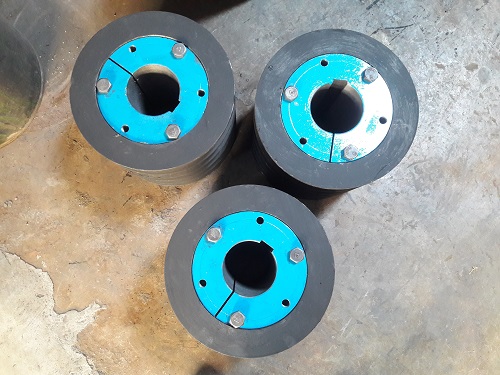
At SHREE GANESH ENTERPRISE, we often receive inquiries where buyers know the belt type but are unsure about pulley dimensions or bore compatibility. Selecting the correct taper lock pulley size requires understanding diameter, groove profile, bush series, and shaft fitment.
This guide explains standard size classifications, bore options, and how to select the right pulley for your application.
1. Understanding Taper Lock Pulley Size Terminology
When reviewing a taper lock pulley size chart, you will typically see the following parameters:
- Outside Diameter (OD)
- Pitch Diameter (PD)
- Belt Section (SPZ, SPA, SPB, SPC)
- Number of Grooves
- Bush Series (e.g., 1210, 1610, 2012, etc.)
- Maximum Bore Size
Each of these factors determines compatibility with your shaft and belt system.
2. Standard Belt Sections and Typical Applications
Different belt sections are designed for different load capacities.
SPZ
- Light-duty applications
- Smaller machinery
- Compact drives
SPA
- Medium-light industrial applications
- Fans, pumps, packaging machines
SPB
- Medium-heavy duty
- Conveyors, compressors
SPC
- Heavy-duty industrial systems
- Crushers, mixers, large conveyors
Choosing the correct belt section is the first step before reviewing diameter options.
3. Common Taper Lock Bush Series and Bore Ranges
Each pulley hub is designed to accommodate a specific bush series. Below is a general reference:
- 1008 Series → Small shafts
- 1210 Series → Small to medium shafts
- 1610 / 1615 Series → Medium shafts
- 2012 / 2517 Series → Medium-heavy applications
- 3020 / 3535 Series → Heavy-duty shafts
- 4040 / 4545 Series → Large shaft diameters
Each bush series supports a range of bore sizes. The maximum bore depends on bush design and torque capacity.
Always confirm that the bore size exactly matches your measured shaft diameter.
4. How to Read a Taper Lock Pulley Size Example
Example:
SPB 200-3 (2517)
This typically means:
- SPB → Belt section
- 200 → Approximate pitch diameter (mm)
- 3 → Number of grooves
- 2517 → Bush series
This indicates the pulley accepts a 2517 taper lock bush, which supports a specific bore range.
5. Selecting the Correct Diameter
Pulley diameter affects:
- Speed ratio
- Torque output
- Belt life
- Center distance
Use the formula:
Driver RPM × Driver Diameter = Driven RPM × Driven Diameter
Ensure the selected diameter:
- Meets speed requirement
- Does not fall below minimum recommended belt diameter
- Fits within machine space
Larger diameters generally improve belt life but require more installation space.
6. Bore Size Selection Guide
To select the correct bore:
- Measure shaft diameter accurately
- Confirm shaft tolerance (h6 or similar)
- Choose bush series compatible with pulley
- Verify bore availability within that bush range
Never modify bore size manually. Always use factory-machined bush bores for precision fit.
7. Quick Selection Checklist
Before finalizing your taper lock pulley size, confirm:
- Motor power (kW or HP)
- Operating RPM
- Required speed ratio
- Belt section
- Number of belts required
- Shaft diameter
- Available installation space
- Service factor
Correct sizing ensures efficient torque transmission and longer equipment life.
8. Common Sizing Mistakes to Avoid
- Choosing pulley based only on outer diameter
- Ignoring pitch diameter
- Selecting incorrect bush series
- Assuming shaft size without measurement
- Not checking minimum belt diameter limits
Accurate selection prevents slippage, vibration, and premature wear.
Final Thoughts
A taper lock pulley size chart is more than a list of diameters. It represents the relationship between belt profile, bore compatibility, torque capacity, and operating conditions.
By understanding dimensions, bush series, and application requirements, you can confidently select the correct pulley for reliable and long-term industrial performance.
