
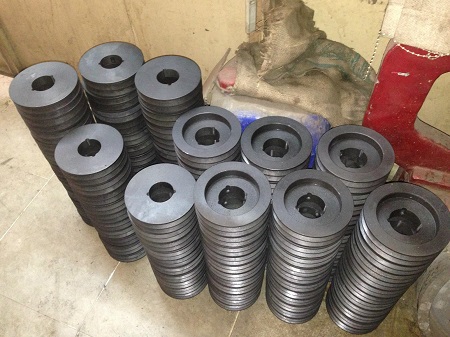
Choosing the right type of pulley is not just about matching belt size or cost. It directly influences machine performance, maintenance ease, and long-term reliability. At SHREE GANESH ENTERPRISE, we regularly guide customers through this comparison because selecting the wrong pulley type can increase downtime and long-term operational cost.
This guide explains the key differences, advantages, and practical selection points so you can decide confidently.
What Is a Taper Lock Pulley?
A taper lock pulley uses a removable tapered bush to clamp securely onto the shaft. When the screws are tightened, the bush wedges into the pulley hub and grips the shaft firmly. This system creates strong torque transmission without welding or permanent press fitting.
What Is a Solid Pulley?
A solid pulley has a fixed bore and is directly fitted onto the shaft. It typically requires:
- Press fitting
- Shrink fitting
- Bore machining
- Keyway cutting
Once installed, it is more permanent and not as easy to remove.
Installation and Removal
Taper Lock Pulley:
- Quick installation
- Easy removal using jacking holes
- No shaft damage
- Minimal tools required
Solid Pulley:
- Requires press or heating
- Removal may damage shaft
- More labor-intensive
For maintenance-friendly environments, taper lock pulleys are usually preferred.
Flexibility and Interchangeability
Taper Lock Pulley:
- One pulley can fit multiple shaft sizes by changing the bush
- Simplifies spare management
- Reduces inventory cost
Solid Pulley:
- Each pulley is shaft-specific
- Requires separate machining for different shaft sizes
Taper lock systems offer greater operational flexibility.
Cost Comparison
Initial Cost:
Solid pulleys may appear slightly cheaper.
Lifecycle Cost:
Taper lock pulleys often save money due to easier maintenance, faster replacement, and reduced downtime.
When evaluating cost, consider total operational impact — not just purchase price.
Torque Transmission and Strength
Taper Lock Pulley:
- Strong clamping grip
- Reliable torque transmission
- Suitable for most industrial loads
Solid Pulley:
- Permanent fit
- Excellent for continuous heavy shock loads
For extreme impact applications, solid pulleys may offer an advantage, but for most industrial systems, taper lock pulleys perform reliably.
Maintenance and Downtime
In modern industrial plants, downtime is expensive.
Taper lock pulleys provide:
- Faster replacement
- Easy shaft protection
- Lower maintenance time
- Reduced risk of shaft damage
Solid pulleys may require more effort and time during removal.
When Should You Choose a Taper Lock Pulley?
- When maintenance efficiency is important
- When multiple shaft sizes exist
- When easy removal is required
- When downtime must be minimized
- When interchangeability is preferred
Conveyors, compressors, fans, and packaging systems commonly use taper lock pulleys.
When Should You Choose a Solid Pulley?
- Extremely heavy shock load environments
- Permanent installations
- Special shaft designs
- Applications where frequent removal is not expected
Heavy crushers and rugged machinery may use solid pulleys in specific cases.
Final Thoughts
Both taper lock and solid pulleys have their place in industrial machinery. The correct choice depends on torque requirements, maintenance frequency, installation environment, and long-term cost considerations.
For most modern industrial applications, taper lock pulleys offer better flexibility, easier maintenance, and lower lifecycle cost. However, extreme heavy-duty systems may still benefit from solid designs.
If you need help selecting the right pulley type based on your shaft size, motor power, RPM, and load condition, SHREE GANESH ENTERPRISE can assist with technical guidance tailored to your application.
