
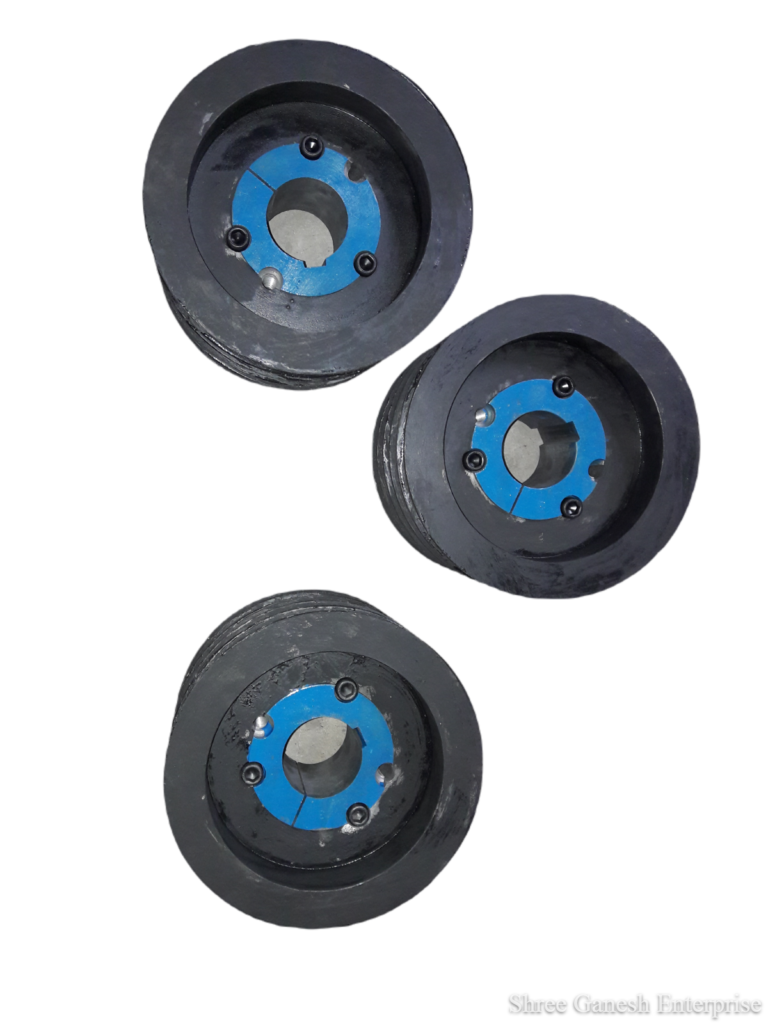
In the global market, taper lock pulleys are not judged only by price. SHREE GANESH ENTERPRISE understands that international buyers evaluate consistency, compliance, finish quality, packaging standards, and long-term reliability before selecting a supplier. Export quality means meeting technical expectations while maintaining uniform production standards across every batch.
If you are targeting overseas markets, understanding what global buyers look for can significantly improve your acceptance rate and repeat orders.
- Dimensional Accuracy and Standard Compliance
International buyers expect pulleys manufactured according to recognized standards such as ISO, DIN, or equivalent regional norms.
They verify:
Groove profile accuracy (SPA, SPB, SPC, etc.)
Pitch diameter precision
Bore and keyway tolerances
Taper bush compatibility
Concentricity and runout limits
Even small dimensional variations can lead to belt misalignment or vibration, which global buyers will not tolerate.
- Consistent Material Grade
Material quality is a major evaluation factor. Buyers expect:
Certified cast iron grades
Uniform chemical composition
Controlled hardness range
No casting porosity or cracks
Material test certificates are often requested, especially for bulk or OEM orders. Consistency across batches builds long-term trust.
- Superior Surface Finish
Export markets pay close attention to finishing quality.
They look for:
Smooth machined surfaces
Clean groove edges
Uniform coating or paint
Proper anti-rust protection
A well-finished pulley reflects manufacturing discipline and attention to detail.
- Dynamic Balancing for High-Speed Use
For applications in Europe, the Middle East, or industrial regions in North America, pulleys may operate at higher speeds.
Buyers may require:
Static or dynamic balancing
Vibration control compliance
Maximum RPM rating confirmation
Balanced pulleys improve reliability and reduce warranty risks.
- Proper Taper Bush Fitment and Interchangeability
International buyers prefer systems that are interchangeable with globally available taper lock bushes.
They check:
Accurate taper angle
Screw positioning
Bush seating quality
Secure shaft grip
Compatibility with standard bush sizes ensures easy maintenance for end users.
- Clear Marking and Traceability
Export-quality pulleys should include clear and permanent markings such as:
Size designation
Groove type
Bush number
Manufacturer identification
Traceability increases buyer confidence and supports quality audits.
- Protective and Export-Grade Packaging
Packaging plays a major role in international shipments.
Buyers expect:
Rust-preventive oil or coating
Individual wrapping
Damage-resistant cartons or wooden crates
Proper labeling and documentation
Poor packaging can damage otherwise high-quality products during transit.
- Documentation and Quality Reports
Professional international buyers often request documentation such as:
Material test certificates
Dimensional inspection reports
Balancing reports (if applicable)
Compliance declarations
Providing organized documentation reflects manufacturing transparency and professionalism.
- Production Consistency and Lead Time Reliability
Beyond technical specifications, overseas buyers evaluate:
Batch-to-batch consistency
On-time shipment performance
Ability to handle repeat bulk orders
Stable supply capability
Reliability in delivery is as important as product quality.
- Competitive Yet Sustainable Pricing
While price matters, international buyers understand that extremely low pricing may compromise quality.
They typically look for:
Fair pricing based on material grade
Transparency in cost structure
Long-term supply partnership
Quality, consistency, and communication often outweigh minor price differences.
Final Thoughts
Export quality taper lock pulleys are not defined by appearance alone. They represent a combination of precise manufacturing, standard compliance, reliable material sourcing, professional packaging, and consistent supply performance.
When technical excellence aligns with disciplined production processes, international buyers are more likely to build long-term partnerships rather than make one-time purchases.
