
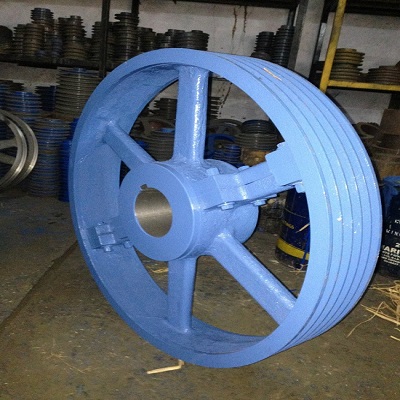
A V-belt pulley is specifically designed to work with V-belts through precise groove angles and sidewall contact. Unlike flat or timing pulleys, its performance depends entirely on how well the belt fits and grips inside the groove.
This means one important thing for buyers
Even slight wear in a V-belt pulley directly affects belt life, grip, and power transmission.
At Shree Ganesh Enterprise, we help industries identify the exact moment when a V-belt pulley stops performing and starts costing money.
Why V-Belt Pulley Replacement Is More Critical
In a V-belt system, power is transmitted through sidewall friction, not the bottom of the groove.
When the pulley wears:
- The belt loses side contact
- Slippage increases immediately
- Heat builds up faster
- Belt life reduces drastically
This is why V-belt pulleys need more attention compared to other pulley types.
Key Signs Your V-Belt Pulley Needs Replacement
1. Belt Sitting Too Deep in the Groove
This is the most important and commonly ignored sign.
In a proper V-belt pulley:
- The belt should sit slightly above the groove base
- Contact should be on the sidewalls
If the belt is touching the bottom:
- Groove has worn out
- Grip is lost
- Replacement is necessary
2. Shiny or Polished Groove Sidewalls
Over time, friction polishes the groove surface.
What this means:
- Reduced friction between belt and pulley
- Increased slipping
- Reduced torque transmission
A polished groove might look smooth, but it is actually less effective.
3. Uneven Groove Wear
In multi-groove V-belt pulleys:
- Some grooves wear faster than others
- Belts carry uneven load
- System becomes unstable
This leads to:
- Unequal belt tension
- Premature belt failure
- Vibration during operation
4. Frequent Belt Replacement
If you are replacing V-belts often, the pulley is usually the problem.
Common pulley-related causes:
- Incorrect groove angle
- Worn-out groove profile
- Surface damage inside grooves
A new belt on a worn V-belt pulley will fail quickly.
5. Belt Slippage Under Load
When your machine is under load:
- Belt starts slipping
- RPM drops
- Burning smell may appear
This is a direct sign that the pulley is no longer gripping properly.
6. Noise and Vibration in V-Belt Drive
A properly functioning V-belt pulley runs smoothly.
Warning signs:
- Squealing noise
- Vibration at startup or load
- Irregular belt movement
These indicate groove wear or imbalance in the pulley.
7. Cracks or Damage Near Groove Edges
In V-belt pulleys, the groove edges handle maximum stress.
Check for:
- Cracks between grooves
- Chipped edges
- Deformation
These can cause sudden belt breakage and must not be ignored.
When Replacement Is Absolutely Necessary
Replace your V-belt pulley immediately if:
- Belt bottoms out in the groove
- Groove angle no longer matches belt profile
- Multiple belts are failing together
- Machine efficiency is dropping without other faults
Delaying replacement in these cases will increase downtime and repair costs.
What Causes Faster Wear in V-Belt Pulleys
Understanding this helps buyers make better decisions:
- Improper belt tension (too tight or too loose)
- Misalignment of pulleys
- Dust, oil, or contaminated environment
- Low-quality pulley material
- Incorrect pulley size or profile selection
A high-quality V-belt pulley with proper machining lasts significantly longer.
Buyer Insight from Shree Ganesh Enterprise
Most buyers make one critical mistake
They replace belts repeatedly but continue using the same worn pulley.
This results in:
- Higher operating cost
- Reduced machine reliability
- Unnecessary downtime
At Shree Ganesh Engineers, we recommend:
- Inspect pulley condition during every belt replacement
- Replace pulley after visible groove wear
- Use precision-machined pulleys for consistent performance
Final Recommendation
A V-belt pulley should be replaced not when it fails, but when it starts affecting belt grip and system efficiency.
If you notice:
- Belt slipping
- Groove wear
- Frequent belt issues
It is time to replace the pulley.
